
Client care letter digital signing: a compliance guide

Client care letter digital signing is the process by which legal and financial firms obtain verified electronic signatures on client engagement documents, replacing paper workflows with legally compliant digital alternatives. The industry term for this document category is the "engagement letter" or "client care letter," and both terms are used interchangeably across UK solicitor practices, accountancy firms, and financial advisory businesses. Firms that adopt electronic signature processes for these documents reduce administrative overhead, accelerate client onboarding, and create defensible audit records that satisfy regulators including the Solicitors Regulation Authority and HMRC. This guide covers automation, compliance obligations, implementation methods, and best practices for professional firms operating under eIDAS, the ESIGN Act, and MLR 2017.
How does client care letter digital signing work in practice?
Client care letter digital signing replaces the traditional cycle of printing, posting, chasing, and scanning with a fully digital workflow. A client receives the letter by email, authenticates their identity, applies an electronic signature, and returns the signed document, all within a single session. The signed file, together with a certificate of completion, is then filed automatically in the firm's practice management system. This process is legally binding under eIDAS in the UK and EU, the ESIGN Act in the United States, and UETA across most US states.
The core benefit is speed. Paper-based engagement letter cycles routinely take days or weeks. Digital signing collapses that timeline to hours or minutes. For firms handling high volumes of new instructions, that difference directly affects how quickly fee earners can begin billable work.

Pro Tip: Set your digital client care agreement template to auto-populate client name, matter reference, and fee structure from your practice management system. Manual re-keying is the single biggest source of error in engagement letter workflows.
How automation transforms the signing process
Automation is the defining difference between a basic e-signature tool and a fully integrated client care document signing workflow. Manual processes require a fee earner to draft the letter, download it, upload it to a signing platform, add signer fields, send it, chase the client, download the signed copy, and re-upload it to the case file. Each step introduces delay and the risk of error.
Integrated workflows eliminate most of those steps. Automating engagement letter workflows reduces admin time by 70–85% compared to manual processes, with some professional services firms reporting that a month of annual admin time compresses to a few hours. That is not a marginal efficiency gain. It is a structural change in how a firm operates.
The table below shows the contrast between manual and automated steps in a typical client care letter lifecycle.
| Stage | Manual process | Automated process |
|---|---|---|
| Document generation | Fee earner drafts from scratch or edits template | System generates from matter data automatically |
| Sending | Manual upload to signing platform, add fields, send | Triggered automatically on matter status change |
| Client authentication | No verification or ad hoc password | Access code or identity verification built in |
| Chasing | Fee earner emails or calls client | Automated reminders sent at defined intervals |
| Filing | Manual download and re-upload to case file | Signed PDF and audit trail filed automatically |
Leading firms automate engagement letters with standardised envelope templates triggered by matter status changes, eliminating manual downloading, uploading, and re-filing entirely. The practical result is that fee earners spend their time on legal work, not document administration. Engagement letter workflow improvements increase billable capacity by removing this low-value administrative work from the fee earner's day.
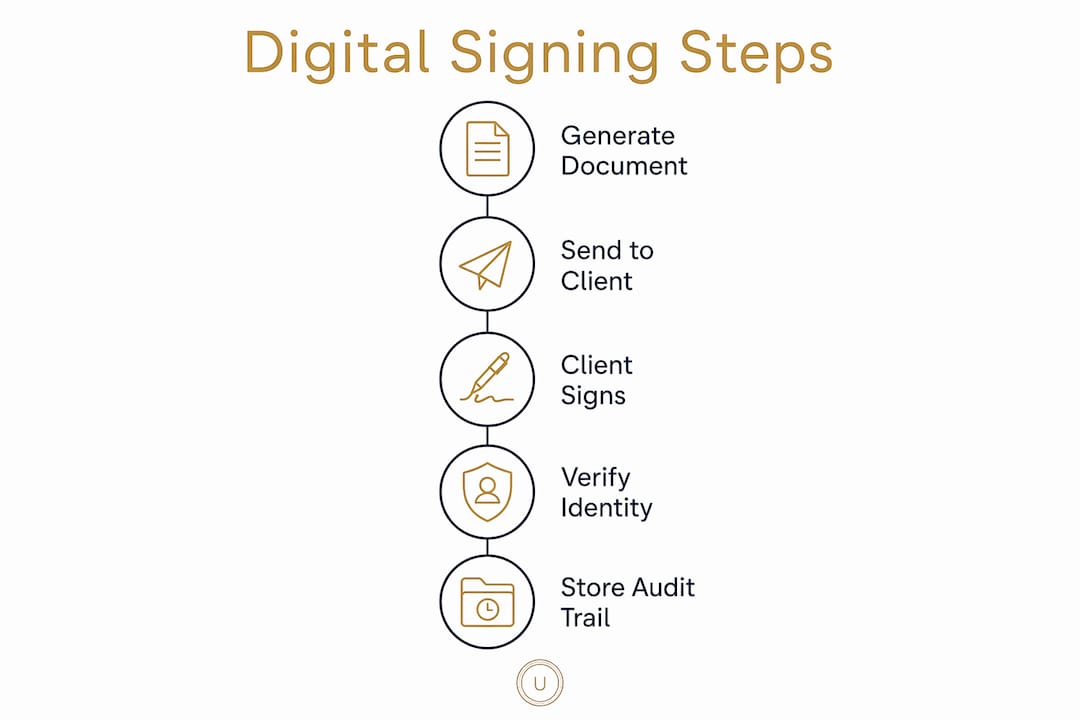
Manual re-keying of documents between practice management and e-signature systems is the most common bottleneck in firms that have adopted basic signing tools without integration. Integrated workflows solve this by enabling automatic document transfer, which reduces both errors and delays.
What compliance and security requirements apply?
Electronic signatures on client care letters must satisfy specific legal and evidentiary standards to be enforceable. The requirements differ by jurisdiction, but three principles apply universally: the signer must be identifiable, the document must be tamper-evident after signing, and a complete audit record must be preserved.
The key compliance obligations for UK and international firms include:
- eIDAS compliance: Electronic signatures used in the UK and EU must meet the standards set under the UK eIDAS regulation retained post-Brexit. Advanced Electronic Signatures (AdES) provide a higher level of assurance and are appropriate for most client care letters.
- Identity verification: Access Code Authentication is preferred over Knowledge Based Authentication for client identity verification during signing. Clients authenticate via a 6–9 digit code, which balances security with ease of use.
- Audit trails: Filing both the signed PDF and the audit trail with signer identity, timestamp, and IP address is required for legal evidence and compliance. A signed letter without an audit trail is incomplete for legal verification.
- Tamper-evident sealing: The signed document must be cryptographically sealed so that any post-signature alteration is detectable.
- Secure platform requirement: Law firms must use secure platforms to protect client identities during signing, whether signatures are applied electronically or by hand with proper verification.
The most common compliance failure is not a defective signature. It is a missing audit trail. Firms that download the signed PDF but discard the certificate of completion lose the evidentiary record that proves when, where, and by whom the document was signed. For cross-border matters, the compliance requirements for international signing add further layers around identity verification and applicable law.
Pro Tip: Store the certificate of completion alongside the signed PDF in every matter file. Regulators and courts require both documents. Filing one without the other is the equivalent of signing a contract but shredding the witness statement.
What technologies support efficient digital signing for firms?
The right technology for client letter e-signature processes depends on the volume of letters your firm sends, the complexity of your signer workflows, and the depth of integration your practice management system supports.
Entry-level signing tools provide a basic send-and-sign function with no practice management integration. They work for low-volume firms but create manual re-keying work at both ends of the process. Enterprise platforms integrate directly with case management systems, auto-populate document fields from matter data, and file completed documents automatically.
The table below compares typical feature categories across capability tiers.
| Feature | Entry-level tools | Integrated platforms |
|---|---|---|
| Document generation | Manual | Automated from matter data |
| Batch sending | Limited or absent | Up to 100 clients per batch |
| Identity verification | Basic email confirmation | Access code or biometric |
| Audit trail | Basic log | Full certificate of completion |
| Practice management sync | Manual re-keying | Automatic two-way sync |
| Automated reminders | Manual follow-up | Scheduled multi-channel chasing |
Batch e-signature sending supports up to 100 clients per batch, but requires complete client data and careful handling of private information. Batch systems require at least two clients selected and prohibit sensitive personal data in shared template fields. This capability is particularly valuable for accountancy firms sending annual engagement letters to their entire client base at the start of a new tax year.
Key capabilities to require from any virtual signing service include:
- Two-way integration with your practice management or CRM system
- Automated document generation from matter or client data
- Multi-channel reminder workflows covering email, SMS, and in-app notifications
- Access code or equivalent identity verification at the point of signing
- Automatic filing of the signed PDF and certificate of completion
- Compliance with eIDAS, ESIGN Act, UETA, and MLR 2017 as applicable to your markets
For firms with legal document signing workflows already in place for other document types, extending those workflows to cover client care letters is the most efficient path. The infrastructure already exists. The configuration work is minimal.
How to establish best practices for digital signing adoption
Adopting secure digital client correspondence requires more than selecting a technology. Firms that achieve consistent results build standard operating procedures around the entire client care letter lifecycle.
Follow these steps to establish a reliable workflow:
- Standardise your templates. Create approved client care letter templates for each matter type. Define which fields auto-populate from matter data and which require manual input. Lock the template structure so fee earners cannot inadvertently alter compliance-critical clauses.
- Define signer order and roles. Decide whether the supervising partner signs before or after the client. Set this as a fixed rule in your signing platform. Inconsistent signer orders create confusion and delay.
- Document your SOPs. Standard Operating Procedures with defined roles reduce manual error and improve consistency across the firm. Assign responsibility for drafting, approval, sending, and follow-up to named roles, not individuals.
- Configure automated reminders. Automated reminders and escalation alerts reduce signing delays and prevent unsigned letters from stalling onboarding. Systems that notify the responsible fee earner after five business days of non-signature are the standard. An automated multi-channel chase cadence covering email, SMS, and voice calls dramatically improves signature rates and reduces expired letters.
- File the complete record. Every completed matter file must contain the signed PDF and the certificate of completion. Automate this filing step so it cannot be skipped.
Pro Tip: Run a quarterly audit of your matter files to confirm that both the signed letter and the audit trail are present. Gaps in your filing are far easier to correct before a regulatory inspection than during one.
Firms that treat the client care letter as a compliance document, rather than an administrative formality, build a stronger evidentiary position and a more consistent client experience. The risks of poorly managed engagement letters extend beyond regulatory censure to professional indemnity exposure.
Key takeaways
Client care letter digital signing is legally enforceable under eIDAS, the ESIGN Act, and UETA, provided firms capture both the signed document and a complete audit trail for every instruction.
| Point | Details |
|---|---|
| Automation reduces admin time | Integrated workflows cut engagement letter admin by 70–85%, freeing fee earners for billable work. |
| Audit trails are mandatory | Filing the signed PDF without the certificate of completion leaves the signature legally incomplete. |
| Access code authentication is preferred | A 6–9 digit access code balances client ease with the identity verification standards regulators require. |
| Batch sending requires clean data | Batch e-signature tools support up to 100 clients per send, but require complete and accurate client records. |
| SOPs prevent inconsistency | Defined roles, locked templates, and automated reminders eliminate the manual errors that create compliance gaps. |
Signflownow's view on where firms go wrong
The firms that struggle most with digital signing adoption are not the ones that chose the wrong platform. They are the ones that digitised the signature step without redesigning the workflow around it. They replaced a wet ink signature with an electronic one, but kept every other manual step intact. The result is a process that is marginally faster but just as fragile.
The audit trail problem is more widespread than most firms realise. Fee earners download the signed PDF, file it in the case management system, and consider the matter closed. The certificate of completion, which contains the signer's IP address, timestamp, and authentication record, is left in the signing platform's sent folder until it expires. When a client disputes a fee or a regulator requests evidence of engagement, the firm has a signed document but no proof of who signed it or when. That is not a compliance record. It is a liability.
The firms that get this right treat the certificate of completion as a primary document, not an optional attachment. They automate its filing alongside the signed letter, so the step cannot be skipped regardless of which fee earner handles the matter. That single procedural change resolves the most common evidentiary gap in digital signing workflows.
The technology is not the hard part. The discipline is.
— Sign Flow Now
Signflownow: digital signing built for professional firms
Signflownow is an AI-native e-signature and compliance platform built specifically for solicitors, accountants, estate agents, and financial advisers. It combines legally binding e-signatures with built-in AML screening, HMRC Agent Authorisation, client onboarding packs, and payment collection at the point of signing, all within a single compliant workflow.
For firms managing high volumes of client care letters, Signflownow automates document generation, identity verification, multi-channel reminders, and audit trail filing in one connected process. It operates across UK, US, Canada, Australia, and EU markets and is compliant with MLR 2017, eIDAS, ESIGN Act, UETA, AUSTRAC, FINTRAC, and AMLD6. Explore the team signing solution to see how Signflownow fits your firm's existing workflows.
FAQ
What is a client care letter in digital signing?
A client care letter is a formal engagement document sent by a solicitor or financial adviser to a new client, setting out the terms of the retainer, fee structure, and complaints procedure. Digital signing replaces the paper version with an electronically signed equivalent that is legally binding under eIDAS and the ESIGN Act.
Is an electronic signature on a client care letter legally valid?
Yes. Electronic signatures on client care letters are legally valid under eIDAS in the UK and EU, the ESIGN Act in the United States, and UETA across most US states, provided the signing platform captures a verifiable audit trail including signer identity, timestamp, and IP address.
What identity verification method should firms use?
Access Code Authentication is the preferred method for client identity verification during signing. Clients receive a 6–9 digit code that they must enter before the document opens, providing a verifiable authentication record without requiring biometric data.
What happens if the audit trail is missing?
A signed document without an audit trail is incomplete for legal verification. If a client disputes a fee or a regulator requests evidence of the signed engagement, a firm that cannot produce the certificate of completion has no reliable proof of when or by whom the document was signed.
How many clients can be sent letters in a single batch?
Batch e-signature systems support up to 100 clients per send. Batch sending requires complete and accurate client data for every recipient and prohibits sensitive personal information in shared template fields.
Recommended
- Cross-Border Signing Compliance Checklist: 2026 Guide | SignFlow Now
- Legal Document Signing Workflow Checklist: A Professional Guide | SignFlow Now
- E-Signatures and AML Compliance for US CPAs: Form 2848, OFAC Screening and Digital Authorisation | SignFlow Now
- Electronic witness signature rules: a 2026 compliance guide | SignFlow Now